
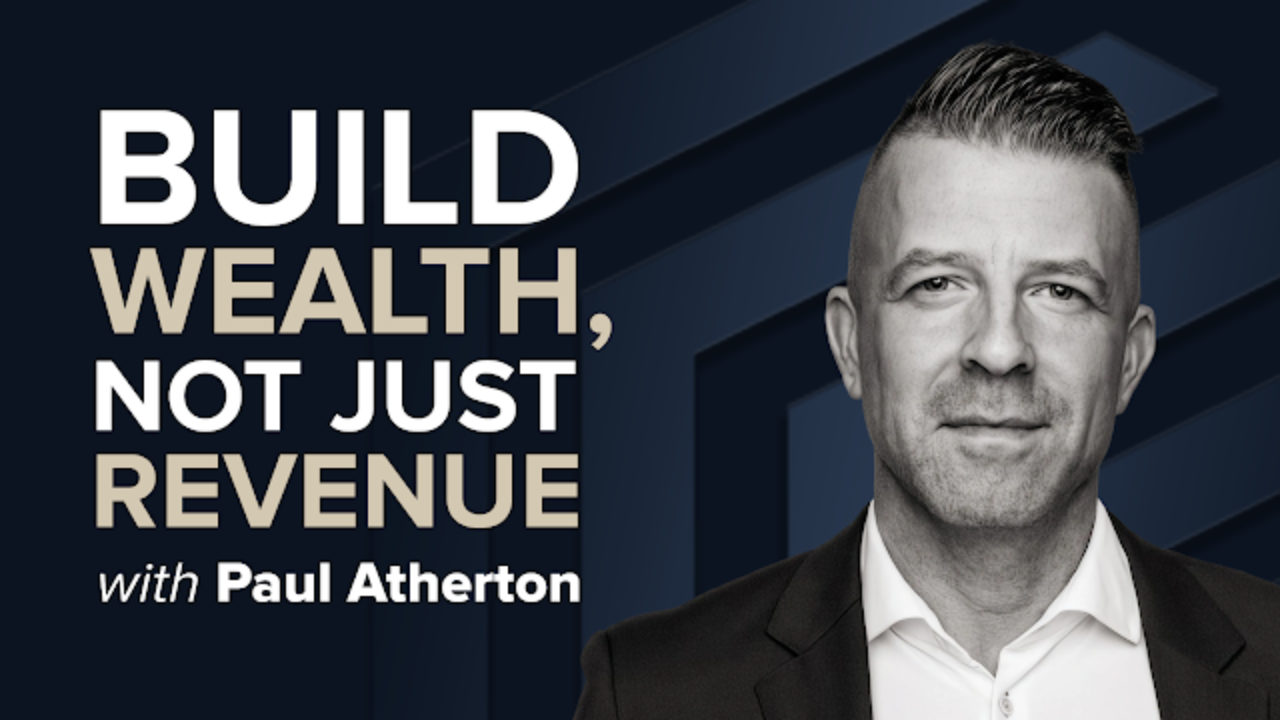
Episode 154: Are You Only Building for Other People?
Sep 22, 2026Most general contractors spend decades becoming very good at one thing:
Building valuable assets for somebody else.
They learn how to estimate, manage labour, control costs and deal with subcontractors. Then, after twenty or thirty years, many owners reach retirement with a profitable construction company and a handful of investments.
That is a good outcome.
But Paul Atherton, CEO and Co-Founder of Highspire, believes there may be a much bigger opportunity hiding inside the business they already built.
In his conversation on the latest episode of The Wealthy Entrepreneur, Paul explains why construction companies are uniquely positioned to become wealth-building machines.
The Business Should Support the Life
Before chasing more revenue, Paul asks owners to get clear on something else:
What are you unwilling to sacrifice?
He calls these anti-goals.
Maybe you refuse to build a bigger company if it costs you family vacations. Maybe date night stays protected. Maybe your workouts remain non-negotiable.
These are not obstacles to growth. They are constraints that force you to build a better company.
When the founder cannot be everywhere, the business needs stronger people, better systems, and clearer accountability. This is the formula that creates a self-managed company.
Build Less System, Not More
Paul sees companies make two mistakes: some barely document anything, while others create giant operating manuals nobody reads.
His answer is the 80/20 rule. Build the 20% of the system that solves 80% of the problem.
Make it clear, concise and usable. Then stop until the business proves that something else needs to be added.
Systems should make work easier, not become another layer of work.
The Three Ways People Build Wealth
Paul breaks wealth creation into three basic activities:
- Operating a profitable company
- Buying and selling assets more efficiently than the market
- Adding value to assets while you own them
Most businesses specialize in one, but as Paul points out, construction companies can potentially do all three.
A successful GC already has the operating company. They understand construction costs and can often evaluate improvement opportunities more accurately than an outside investor. And if they begin acquiring property, they can use their own expertise to create additional value in those assets.
Now the business is not only generating profit; it is helping build a portfolio. And, that changes the wealth equation.
Become Your Own Customer
Paul compares two healthy $10 million construction businesses.
- One owner runs the company for decades and eventually starts investing some of the profits into rental properties
- The other begins using retained earnings earlier to acquire land and uses the construction company to add value to those properties
The second founder used the same capabilities twice. First, to create value for customers, then, to create value for themselves.
But this comes with an important caveat: Not every contractor should rush into development. Paul is clear about the risk - overpay for land, underestimate costs, or build outside an asset class you understand, and one bad development can damage everything you spent years creating.
The advantage only works when discipline comes with it.
Get Out of the Field
None of this happens if the founder is still personally managing every jobsite.
Paul’s advice to smaller contractors is simple: get off the tools.
When working capital can comfortably support a project manager, find someone who shares your values and can own production. Give them clear outcomes, hold them accountable and then get out of their way.
The founder’s time needs to move toward sales, leadership, strategy and growth.
That shift is what creates the space to think beyond next month’s projects.
Build More Than a Construction Company
The goal shouldn’t simply be more revenue.
It should be a company that supports your life, works without your constant involvement and gives you the ability to invest in assets that can compound for decades.
You already know how to build. At some point, the smarter question may be:
Why are you only building for everyone else?
🎧 Listen to the full episode here:
Spotify: https://go.fame.so/WytJ7v-D
Apple: https://go.fame.so/0U-F_7Tk
YouTube: https://youtu.be/p7_iWPqUBt4
If you’d like to be a part of The Wealthy Entrepreneur conversation, let us know here: https://www.wealthyentrepreneur.co/the-wealthy-entrepreneur-podcast-guest-submission. We’d love to have you on the podcast!
Join our Facebook Group for Entrepreneurs
Unlock exclusive sneak peek resources to help scale your business.
Stay connected with news and updates!
Join our mailing list to receive the latest news and updates from our team.
You may unsubscribe at any time.

