
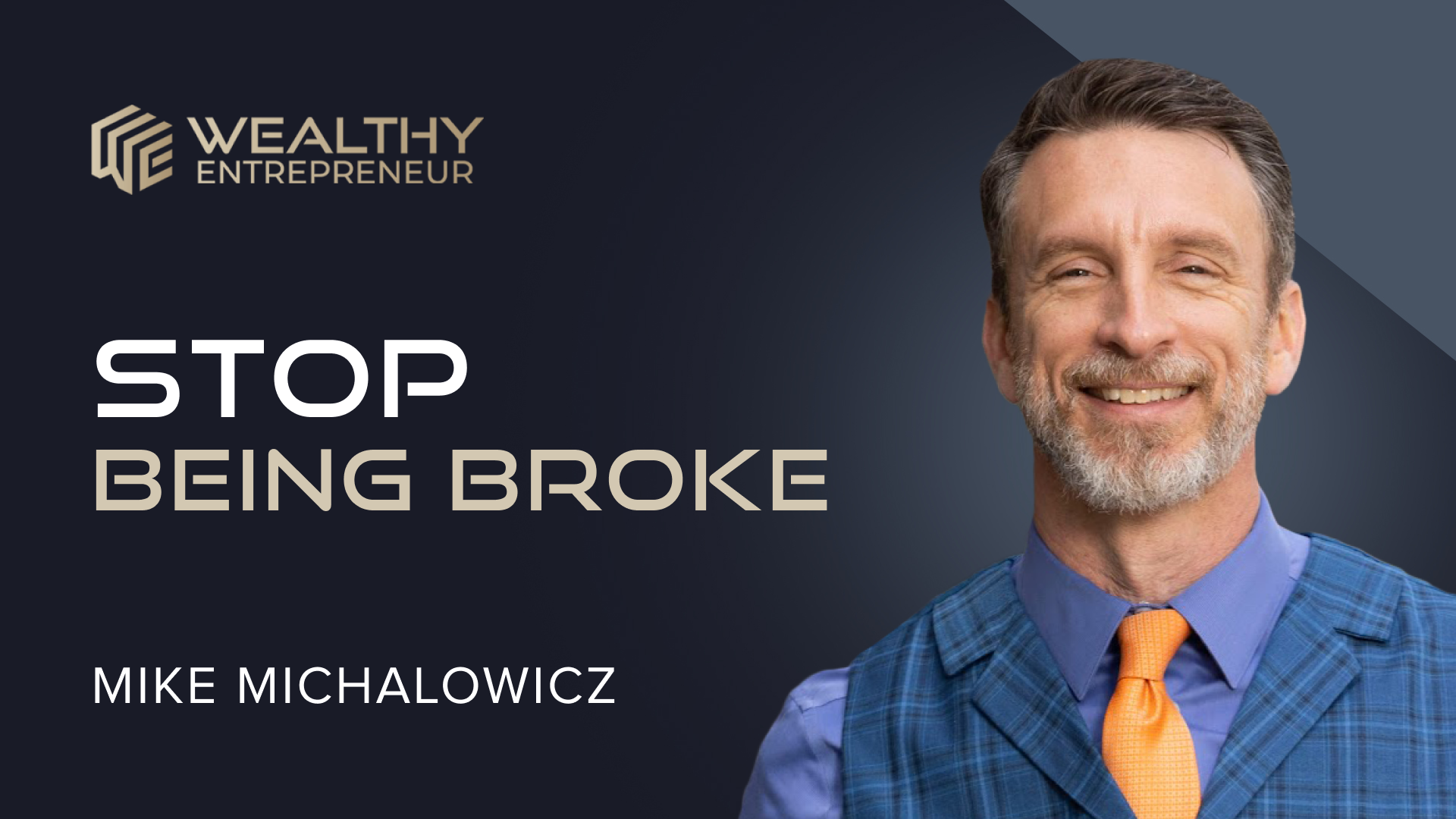
Episode 143: Why Financial Discipline Fails and What You Can Do Instead
Apr 21, 2026For decades, entrepreneurs have been told the same thing:
Work harder, budget better and be more disciplined.
And yet, even highly successful founders often feel like they’re financially out of control - like they’re stuck in a trap. But what if this wasn’t a capability problem; but rather a systems problem.
In the latest episode of The Wealthy Entrepreneur, host Robert Gauvreau welcomed Mike Michalowicz, best selling author and entrepreneur, and what emerged was an entirely different perspective: Most financial systems fail because they require you to become someone you’re not.
Here are the key (and illuminating) takeaways from the episode:
The Hidden Force Behind Financial Chaos
Mike reveals that at the center of the problem is a principle called Parkinson’s Law:
As resources increase, consumption increases at the same rate, leading to a common paradox:
- You earn more, but don’t feel wealthier
- Your business grows, but profit doesn’t stick
- Your lifestyle expands, faster than your income
What’s worse is that when income drops, you don’t scale back, you try to maintain the same lifestyle. It’s this gap that turns into debt, stress and uncertainty. What’s essential to understand is that it isn’t your willpower that’s the problem, it’s your environment that forces you to overspend.
Why Traditional Budgeting Doesn’t Work
Most financial advice relies on two flawed assumptions:
- You’ll consistently follow a plan (you won’t)
- You’ll override your natural behaviour (you can’t)
If we’re being real - it’s not like any of us will open spreadsheets daily. But we will check our bank accounts daily.
Mike emphasizes that the latter is your real behaviour and any system that ignores this will eventually fail.
The Better Approach is to Design Around Human Nature
Instead of fighting behaviour, the solution is to intercept it. At this point in the conversation, Mike reveals the framework that he also introduces in The Money Habit - create separate financial “containers” for different purposes:
- Needs (essentials)
- Wants (lifestyle)
- Dreams (long-term goals)
- Fixed Future (wealth building)
- Emergency (protection)
Now, when you check your bank account (which you already do), you don’t see one large number. Instead, you see purpose-driven amounts. This simple yet profound mindset shift allows you to move from:
Subconscious spending → conscious decisions
Reactive behaviour → intentional allocation
The Real Role of Income
Another critical insight from Mike: income isn’t what solves financial problems. Structure is.
Usually, as income increases, absolute needs stay similar but their percentage decreases, which means higher earners have more opportunity to build wealth, but only if they allocate intentionally.
Mike is quick to warn listeners that without structure, higher income simply fuels:
- Lifestyle inflation
- Overcommitment
- False “needs” (like multiple homes or excessive overhead)
It’s here that the distinction between need vs. responsibility vs. desire becomes essential.
Why Psychology Beats Math (Especially with Debt)
Logically, you should pay off the highest-interest debt first, but behaviourally, that often fails.
Research shows people need early wins to stay motivated and that’s why the “debt snowball” works. Mike shares a step by step process of erasing debt from your financial life, systematically, efficiently and entirely:
- Start with the smallest debts
- Build momentum
- Then shift to the highest-interest debts
While this may not be the fastest path, mathematically, it is the one people actually complete. And, at the end of the day completion is what matters.
Redefining Financial Independence
One of the most powerful moments in the conversation is when Mike offers a powerful shift in how financial independence can be defined:
It’s not a specific age or a retirement milestone - it’s the ability for your money to sustain your lifestyle without active work.
Yet most people never calculate what that actually requires. Instead, they accumulate wealth without a target, always chasing “more,” never reaching “enough.”
At the end of the day, it’s clarity that changes behaviour.
The Bigger Insight
This conversation reveals a broader truth and systems shape outcomes more than intentions. If your system relies on discipline, it will break. If it ignores behaviour, it will fail. And, if it requires constant effort, it won’t last.
But if your system aligns with how you naturally act, creates visibility at the moment of decision and removes temptation through structure, then change becomes sustainable.
The Bottom Line
This conversation reveals that financial success isn’t about becoming more disciplined. It’s about becoming more intentional with the systems you use. Or, as Mike puts it:
Don’t change who you are to achieve financial independence. Channel who you already are.
🎧 Listen to the full episode here:
Spotify: https://tinyurl.com/4ruk8dkx
Apple: https://apple.co/3QxL7I7
YouTube: https://youtu.be/DyaDfcO6nKU
If you’d like to be a part of The Wealthy Entrepreneur conversation, let us know here: https://www.wealthyentrepreneur.co/the-wealthy-entrepreneur-podcast-guest-submission. We’d love to have you on the podcast!
Join our Facebook Group for Entrepreneurs
Unlock exclusive sneak peek resources to help scale your business.
Stay connected with news and updates!
Join our mailing list to receive the latest news and updates from our team.
You may unsubscribe at any time.

