
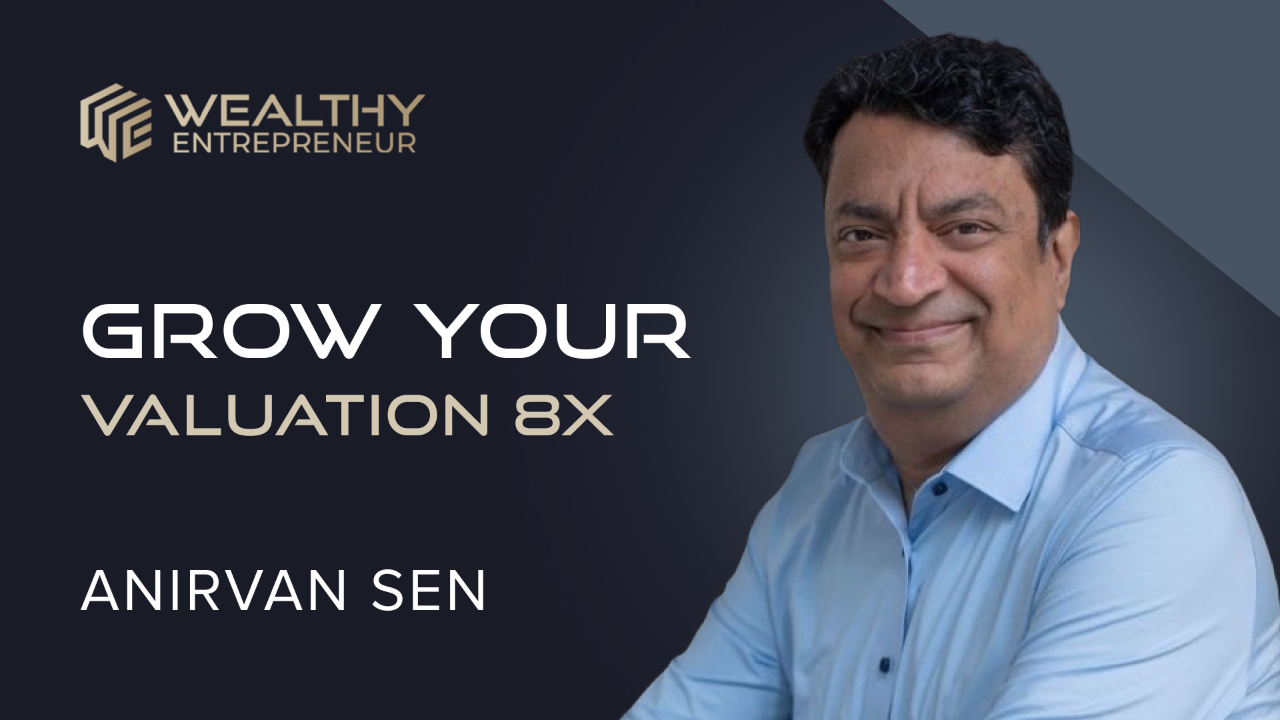
Episode 144: The Buy-and-Build Blueprint That Engineers Wealth, Not Just Growth
May 05, 2026
Most founders think about growth in linear terms: sell more, hire more, expand gradually. And, while this approach is predictable and safe, it can be limiting. Especially, when there’s a different path that doesn’t just grow revenue but redefines valuation, speed and wealth creation altogether.
In the latest episode of The Wealthy Entrepreneur, host Robert Gauvreau sits down with Anirvan Sen, an M&A expert with 25+ years of experience and an author, to unpack said different paths - acquisition-led growth and the buy and build strategy.
As Anirvan puts it, “Buy and build is a fantastic way to grow rapidly.” Here are the key takeaways from their conversation.
Growth vs. Wealth - Why You Should Focus on Both
Anirvan reveals a fundamental yet profound difference - organic growth builds a business, while acquisition-led growth builds an asset.
And, here’s why that distinction matters: A $25M company growing steadily might command a 4-5x multiple. But that same company, after consolidating several acquisitions and reaching $100M+, can command 8x or more without fundamentally changing profitability.
That’s not incremental improvement. That’s valuation arbitrage.
Acquisition Timing is Everything
The biggest mistake founders make isn’t choosing the wrong acquisition. It’s acquiring too early.
There’s a clear progression:
$5–15M: Founder-driven chaos
$15–30M: Platform setting
$30–60M: Acquisition-ready
$60M+: Institutional scale
Anirvan bluntly states that “Anything that you may have acquired prior to that, your company was not ready.” Why? Because at lower stages, teams are stretched thin, processes are informal and leadership is reactive. Add an acquisition to that and the system breaks.
His golden rule: Acquisition success starts with internal readiness, not external opportunity.
Why 70% of Acquisitions Fail
Here’s the uncomfortable truth: most acquisitions don’t fail because of bad strategy. They fail because of poor integration.
“Integration is where the real value creation happens but it’s messy,” Anirvan notes. And because it’s messy, leaders avoid it. Instead, they focus on synergies, cost savings and systems, while the most important asset - revenue - quietly deteriorates.
His advice is unequivocal: “The first thing when you acquire a company [is] revenue ring fencing. It is the number one thing.”
Because, as we all know, without revenue, the business doesn’t exist.
Navigating Talent and Culture Shock
Anirvan emphasizes that after every acquisition, there’s an invisible friction point: expectation mismatch.
He further points out an important inflection point that most miss - a $10M company operates on speed, autonomy and informal culture. A $100M company operates on structure, governance, and accountability.
The mistake, Anirvan notes, is trying to force a single unified culture.
In reality, successful companies build aligned micro-cultures, anchored by shared values but reinforced through systems - structures, practices and rituals.
Remember: Culture doesn’t change through slogans. It changes through how the business operates daily.
The Founder Has to be an Architect
There’s another shift happening beneath all of this - one that determines whether founders actually benefit from growth.
At $20–30M, most founders are still deep in operations. But as businesses scale through acquisitions, something changes. “You’re not spending as much time in the business. You’re spending more time on the business,” Anirvan says.
That shift, from operator to strategist, is where personal wealth creation accelerates. Because now, the founder isn’t just running a company. They’re allocating capital, building relationships and shaping a portfolio.
The Big Lesson
Buy-and-build isn’t a shortcut - it’s a strategic and disciplined approach to wealth engineering that requires:
- Platform readiness before expansion
- Obsession with revenue protection post-acquisition
- Transparency with leadership to retain talent
- Systems-driven culture integration
- A founder willing to evolve beyond operations
And, while most founders chase growth, the best one design for multiples. Because in the end, the goal is to build a business that’s exponentially more valuable, not just one that grows.
🎧 Listen to the full episode here:
Spotify: https://tinyurl.com/4k7xc4sh
Apple: https://apple.co/4erYtQj
YouTube: https://youtu.be/0Cml7OKv67A
If you’d like to be a part of The Wealthy Entrepreneur conversation, let us know here: https://www.wealthyentrepreneur.co/the-wealthy-entrepreneur-podcast-guest-submission. We’d love to have you on the podcast!
Join our Facebook Group for Entrepreneurs
Unlock exclusive sneak peek resources to help scale your business.
Stay connected with news and updates!
Join our mailing list to receive the latest news and updates from our team.
You may unsubscribe at any time.

