
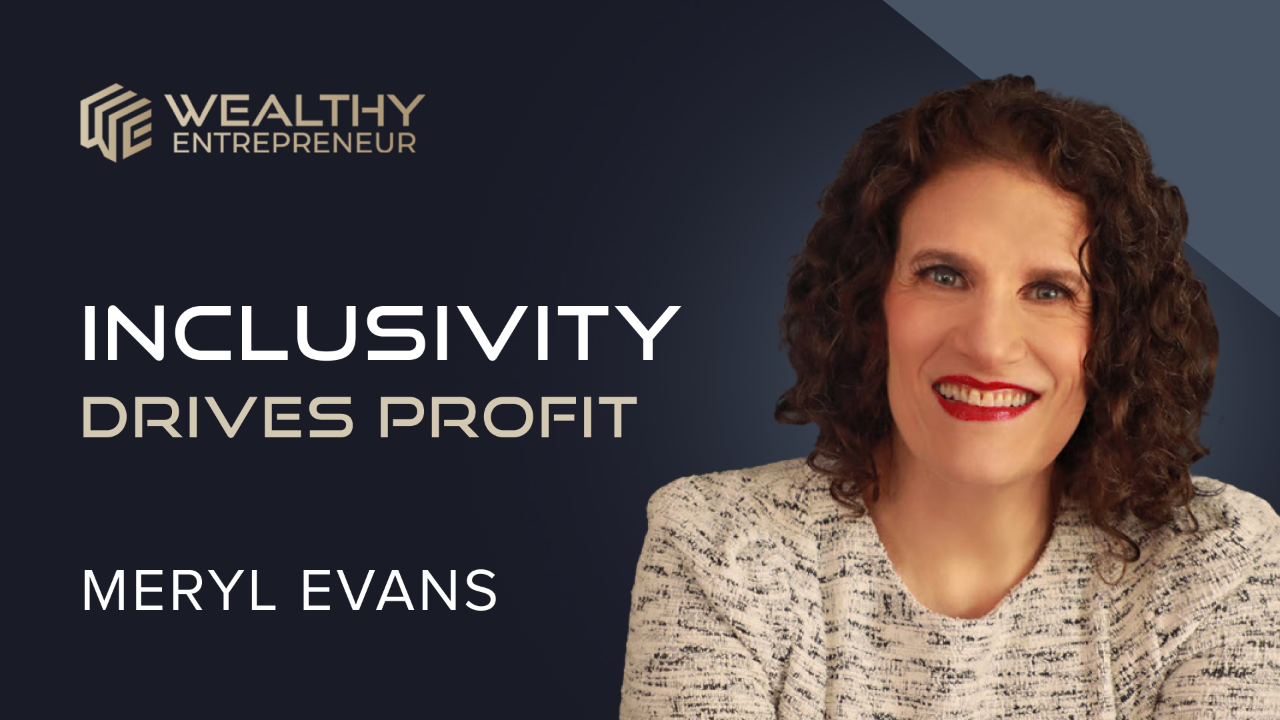
Episode 141: Why Accessibility is the Entrepreneurial Secret You’ve Been Looking For
Mar 24, 2026When leaders hear the word accessibility, most think about compliance.
But accessibility is something far more powerful than that.
As Meryl Evans, renowned accessibility strategist and speaker, puts it, it’s operational design.
In a recent conversation on The Wealthy Entrepreneur podcast, Meryl joins host, Bob Gauvreau, to explain why accessibility is not just a social initiative - it’s a business advantage that improves productivity, retention and scalability.
Meryl’s Story and How it Shaped Her
Meryl’s perspective comes from lived experience. Born profoundly deaf, she spent her life navigating communication barriers that most people never notice. And that experience gave her an unusual insight into how organizations actually function.
According to Meryl, most business challenges can be traced back to three underlying issues:
- Communication breakdowns
- Unclear processes
- Limited access to information
When systems rely on people to “figure things out,” friction increases. And, that’s never a good thing.
Accessibility as the Cure for Friction
When friction arises, decisions become inconsistent, work slows down and employees spend more time interpreting expectations than executing them.
As Meryl puts it:
“If your process only works because people fill in the gaps themselves, that’s not a process. That’s a problem waiting to happen.”
Accessibility addresses that problem directly.
The Entrepreneur’s Wealth Ceiling
The Direct Link Between Accessibility and Productivity
Meryl explains that when employees receive information before they need it (and in a format they can easily use), they spend less time decoding instructions. Meetings become more productive, decisions get made faster and execution improves.
Essentially, accessibility practices like agendas, summaries and clear documentation eliminate the “What are we doing?” moments that waste hours every week.
How Accessibility Changes Retention Outcomes
Contrary to popular belief, people don’t leave their jobs because of flexibility. They leave because of the presence of confusion and the lack of clarity. When processes are unclear or communication is inconsistent, people feel constantly behind. Over time, that leads to frustration and burnout.
On the other hand, employees stay longer in environments where they can do their best work. But when systems are predictable and accessible, employees feel supported.
They trust the organization, and as we all know, trust is one of the most powerful drivers of retention.
Trust and Collaboration Grow Too
Meryl reveals that accessibility also creates transparency because when information flows consistently and expectations are documented, teams know how decisions are made and what they are responsible for.
This reduces confusion and strengthens collaboration. So, instead of relying on informal conversations or insider knowledge, the entire team operates from the same playbook.
Accessibility is a Universal Benefit
One of the most important revelations from this conversation is that solutions created for specific needs often benefit everyone.
Meryl brings this to life through a simple example - curb cuts. The ramps built into sidewalks were originally designed for wheelchair users. But today they’re used by parents pushing strollers, travellers rolling suitcases and delivery workers moving carts.
She points out that the same concept applies inside organizations. Features originally intended to improve accessibility, such as captions, written instructions or structured workflows, often become productivity tools for the entire workforce.
For this reason, it’s important to reframe the idea of accessibility - from one about special treatment to one about designing systems that work better for more people.
The Leadership Mindset Shift
As Meryl emphasizes, the most important factor in building accessible organizations isn’t technology or policy. It’s a leadership mindset.
She suggests that employees take their cues from the top and if leaders treat accessibility as a compliance requirement, it will always remain an afterthought. But when leaders treat accessibility as part of how the business operates, it becomes embedded in the culture.
That means:
- Clear expectations
- Transparent communication
- Documented processes
- Predictable workflows
These practices benefit every employee and they help organizations scale more effectively.
The Big Lesson about Accessibility
As remote and hybrid teams continue to expand, accessibility will become even more critical. As pointed out, distributed teams expose operational weaknesses quickly, while unclear communication, undocumented decisions and inconsistent workflows create friction that slows growth.
By forcing organizations to design systems that are usable, repeatable and resilient, accessibility closes those gaps.
Companies that adopt these principles will be able to scale faster because their processes don’t rely on a single person holding everything together.
Their systems work for everyone. And, when you think about it, that’s the real promise of accessibility - not just inclusion, but better business design.
🎧 Listen to the full episode here:
Spotify: https://tinyurl.com/3te7u3pu
Apple:https://apple.co/4t6Rct7
YouTube: https://youtu.be/oq8guHMg1ZE
If you’d like to be a part of The Wealthy Entrepreneur conversation, let us know here: https://www.wealthyentrepreneur.co/the-wealthy-entrepreneur-podcast-guest-submission. We’d love to have you on the podcast!
Join our Facebook Group for Entrepreneurs
Unlock exclusive sneak peek resources to help scale your business.
Stay connected with news and updates!
Join our mailing list to receive the latest news and updates from our team.
You may unsubscribe at any time.

